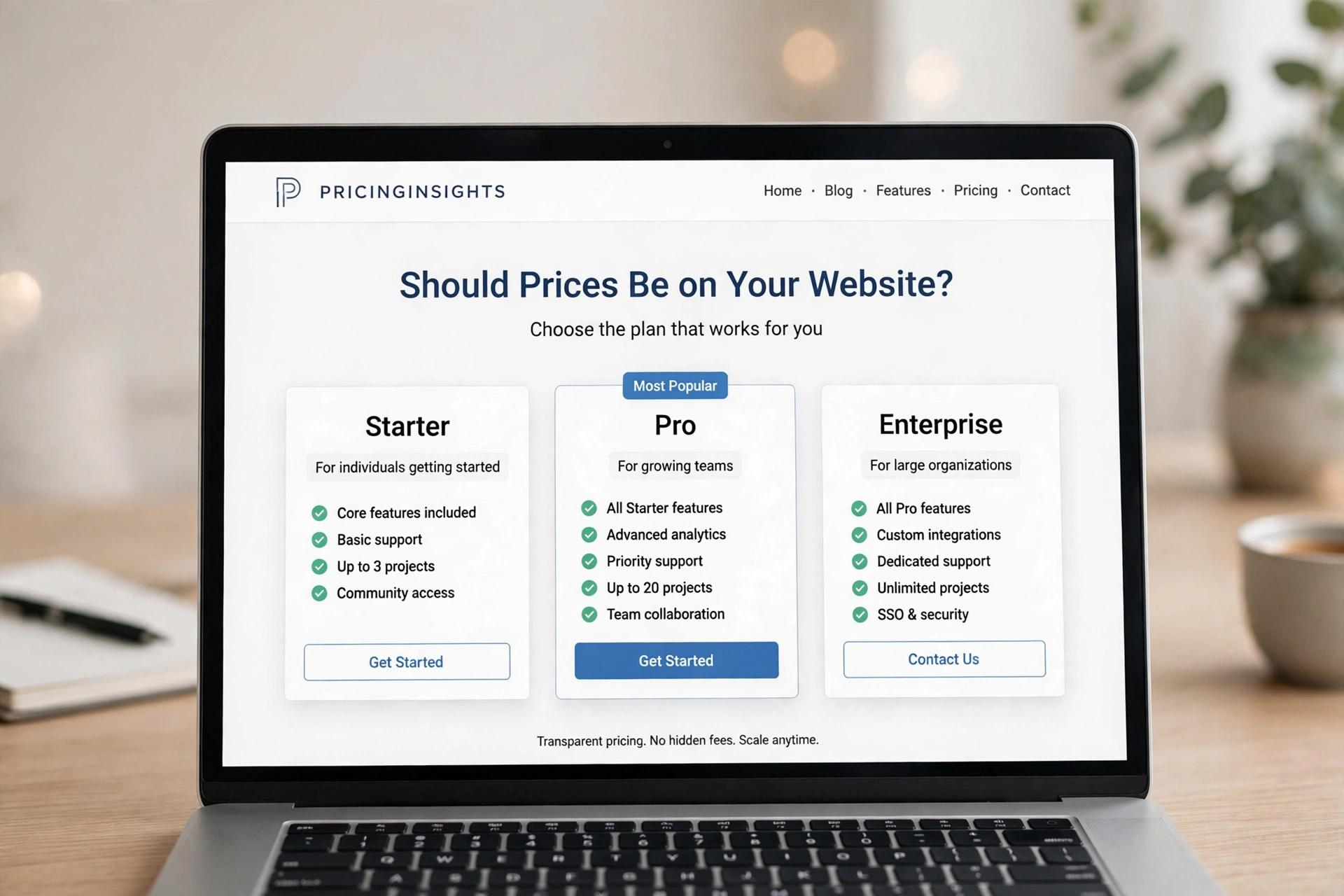
Hiding your prices does not create more leads. It creates more of the wrong conversations. Here is when to publish them, when to show a range, and what to do instead of “call for a quote.”
Your homepage has five seconds to answer what you do, who it is for, and how to reach you. Price is often the fourth question a visitor is already asking — and if your site dodges it, they do not assume you are premium. They assume you are expensive, or that contacting you will be a sales pitch.
That does not mean every business should publish a single fixed price. The honest answer is: it depends on how standardized your work is.
When to publish your prices
If your work is repeatable — a defined service, a standard package, a product with clear options — publish the price. Visitors can self-select, and the people who contact you already know the range. That saves both sides a discovery call that was only ever going to end in “that is more than I expected.”
Published prices also build trust. A visitor who sees what is included, what is not, and what the next step costs is far more likely to reach out than one who has to guess.
When a range is better than a number
Most service businesses are not selling one identical thing. A website, a renovation, a wedding package — the final price depends on scope. In that case, publish a starting price or a range, and say what moves it up or down.
“Starting at” is honest only if you also say what “starting” includes. A range without context is just a vaguer version of hiding the price.
When “call for a quote” actually hurts
“Call for a quote” makes sense for genuinely custom work, where you cannot price it without a conversation. It hurts when it is used as a shield — when you could give a range, but would rather qualify people on the phone first.
Ask yourself: if a competitor published their prices and you did not, who would a price-sensitive visitor contact first? Usually the one who answered the question.
A practical way to handle it
- Publish prices for anything standardized.
- Publish a starting price or range for custom work, with what affects the final number.
- Put the price near the offer, not buried on a separate page no one finds.
- If you do need a conversation first, say why — “pricing depends on scope, so we start with a short call” — and make booking that call easy.
You do not need to win every visitor. You need to win the right ones, and price transparency is one of the fastest ways to filter for them.
If your website is not answering the questions visitors are already asking — price included — that is a fixable problem. Get a concept design FREE to see the direction before the commitment: https://blueprintwebdev.com